The Attack Surface Has to Change — Working Beyond the Algorithm
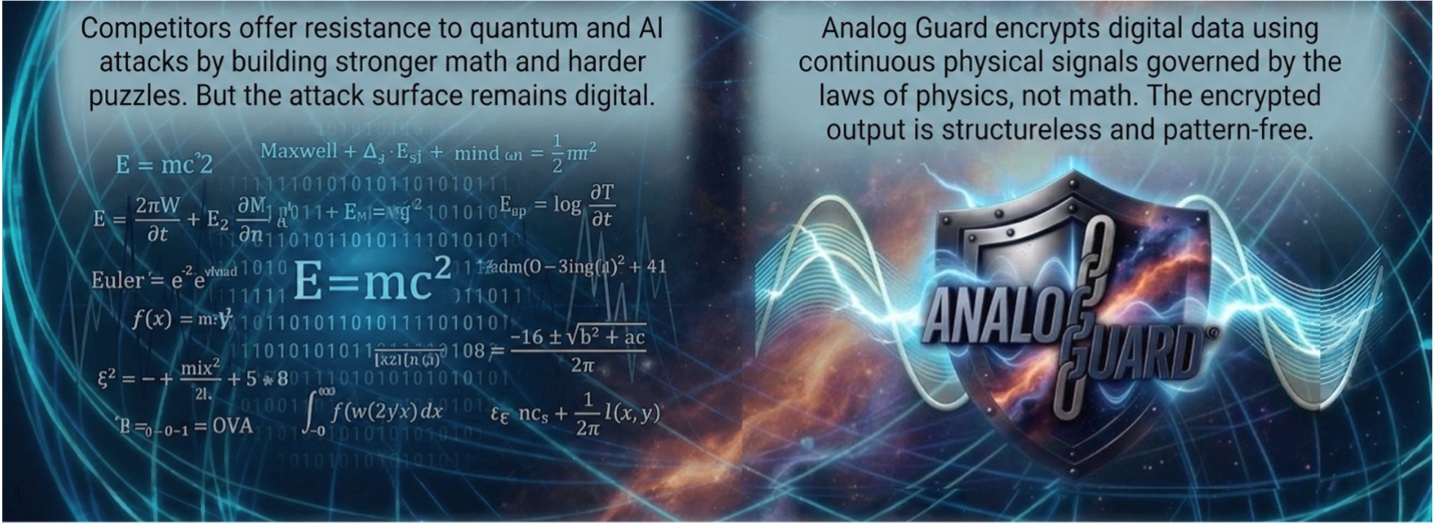
Much of cybersecurity continues investing in stronger algorithms and harder mathematical puzzles — yet these approaches share a structural constraint: the attack surface itself remains digital, remote, and infinitely replicable.
Quantum computing and AI-accelerated adversaries shift that balance in the attacker's favor. They don't need a conceptual break — only enough compute to erode the hardness assumptions traditional cryptography rests on.
Analog Guard takes a different foundation. Rather than iterating on algorithmic defense, we moved encryption into the physical domain — encrypting digital data through continuous analog signals in dedicated hardware, where security no longer depends on a computational puzzle an adversary can outpace.
This is not an incremental improvement on legacy security architecture — it's a new category of cybersecurity infrastructure.
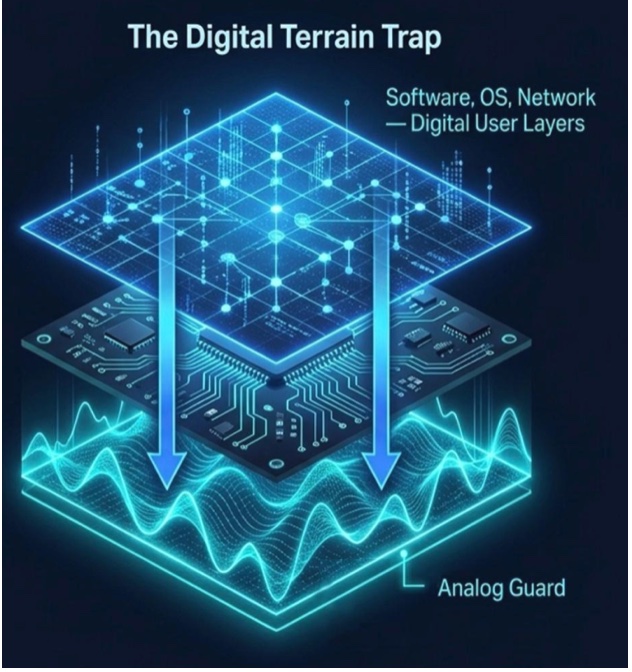
The Digital Terrain Trap
Software encryption and the hardware roots of trust beneath it — OS protections, HSMs, Trusted Execution Environments — share a common attack surface: it is reachable digitally, and its security ultimately rests on mathematical hardness assumptions that an adversary with enough compute can erode.
The joint CISA/NSA/NIST Cybersecurity Information Sheet Quantum-Readiness: Migration to Post-Quantum Cryptography (August 2023) formally warned that adversaries are already harvesting encrypted data today with the intent of decrypting it once a sufficiently capable quantum computer exists. Data protected by current public-key cryptography has, in effect, a published expiration date.
Recent CISA advisories on PRC state-sponsored persistence inside U.S. critical infrastructure (AA24-038A, February 2024) underscore that adversaries are already inside the networks where this harvested data lives.
Analog Guard operates below this layer, in the physical substrate. Because its security does not rest on a mathematical hardness assumption, the attacks that scale against digital encryption — large-scale cryptanalysis, AI-accelerated search, quantum algorithms targeting factoring and discrete logarithms — have no foothold. Compromise requires cloned hardware and synchronized analog keys, one device at a time.
This is the gap Analog Guard was built to close. Not with better math — but at a layer where no mathematical puzzle is waiting to be solved.
Notes vs. Symphony: Discrete Keys vs. Continuous Ones
To understand why Analog Guard is fundamentally different, consider the difference between written sheet music and a live orchestral performance.
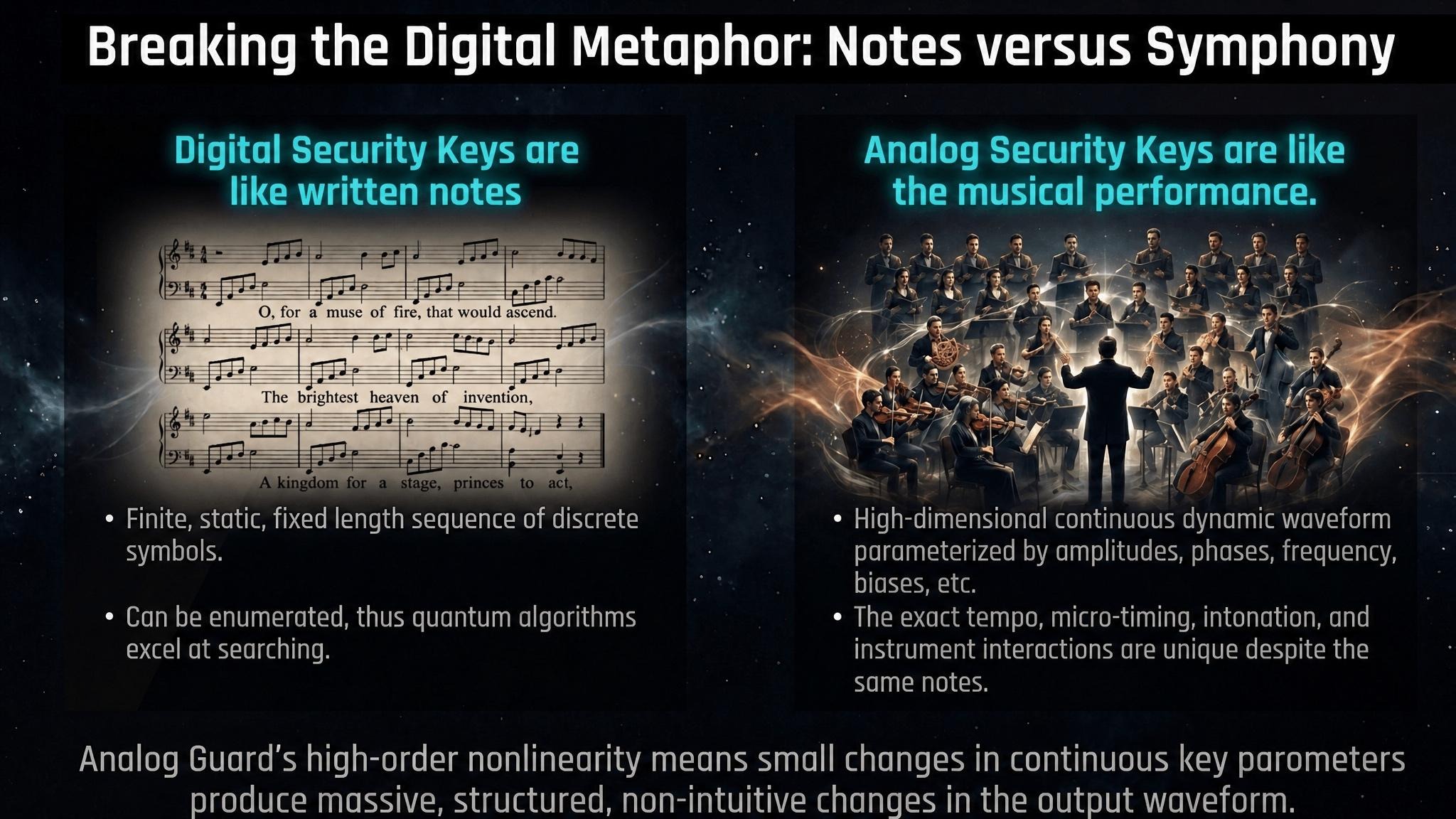
The sheet music can be stolen. The performance cannot.
Every Digital Architecture Has a Known Point of Failure
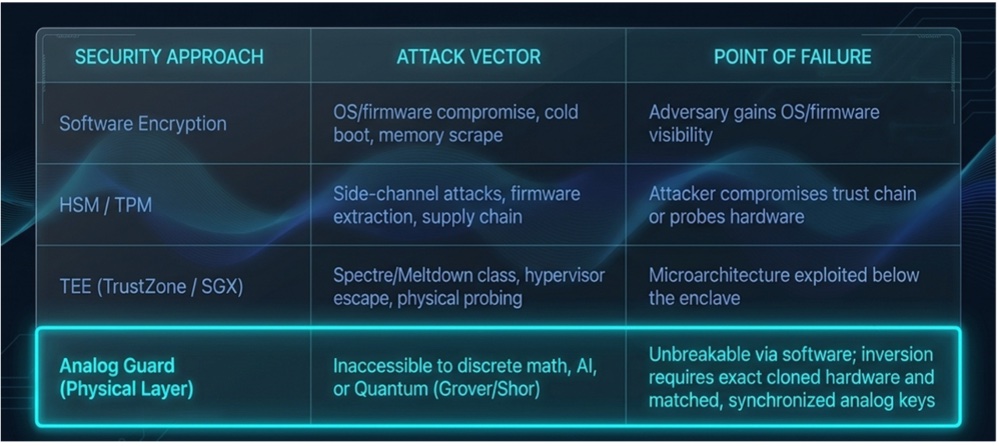
Software encryption of actively used data is vulnerable once an attacker reaches kernel or firmware level, because keys and plaintext are exposed in memory. Hardware Security Modules and TPMs have faced documented side-channel and supply-chain attacks. Trusted Execution Environments have been weakened by microarchitectural flaws like Spectre and Foreshadow, even where mitigations have since shipped.
What these surfaces share is the digital domain — where compromise is remote, scalable, and cheap to replicate once developed.
Analog Guard places the critical secret in the physical substrate. Breaking it isn't a matter of better software or more compute; it requires physical possession of cloned hardware and synchronized analog keys. That shifts the attacker's economics from remote, one-to-many exploitation to local, per-device effort.
That is the difference between scalable compromise and per-device effort.