Containment, Not Replacement
Analog Guard does not displace the cryptographic standards organizations already depend on — AES, post-quantum KEMs, and protocol-level digital cryptography remain part of the stack, doing the work they were designed to do.
Analog Guard contains them, enclosing the entire digital security architecture inside a hardware-tied physical layer, outside the reach of attacks confined to the digital domain.
The architecture works in concentric layers. At the core sits the data payload. Around it, conventional protocol-level cryptography provides the mathematical protection the industry already relies on. Analog Guard then envelops that entire layer with hardware-rooted physical security — generating continuous, dynamic analog signals that present no digital surface for remote or scalable attack.
Existing investments are preserved. The attack surface is what changes. Defense in depth at the physical layer.
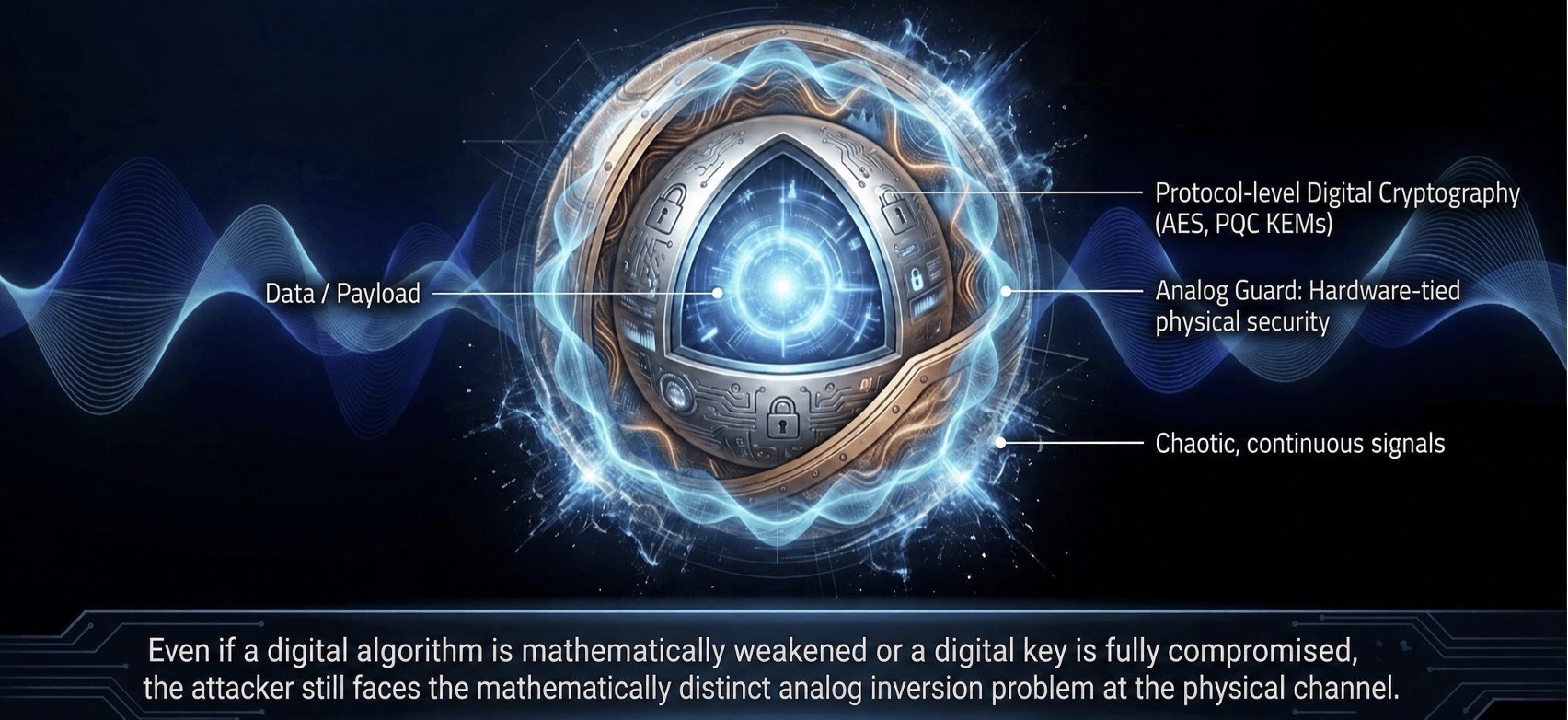
The stack stays. The perimeter changes.
The Operational Lifecycle: Four Stages
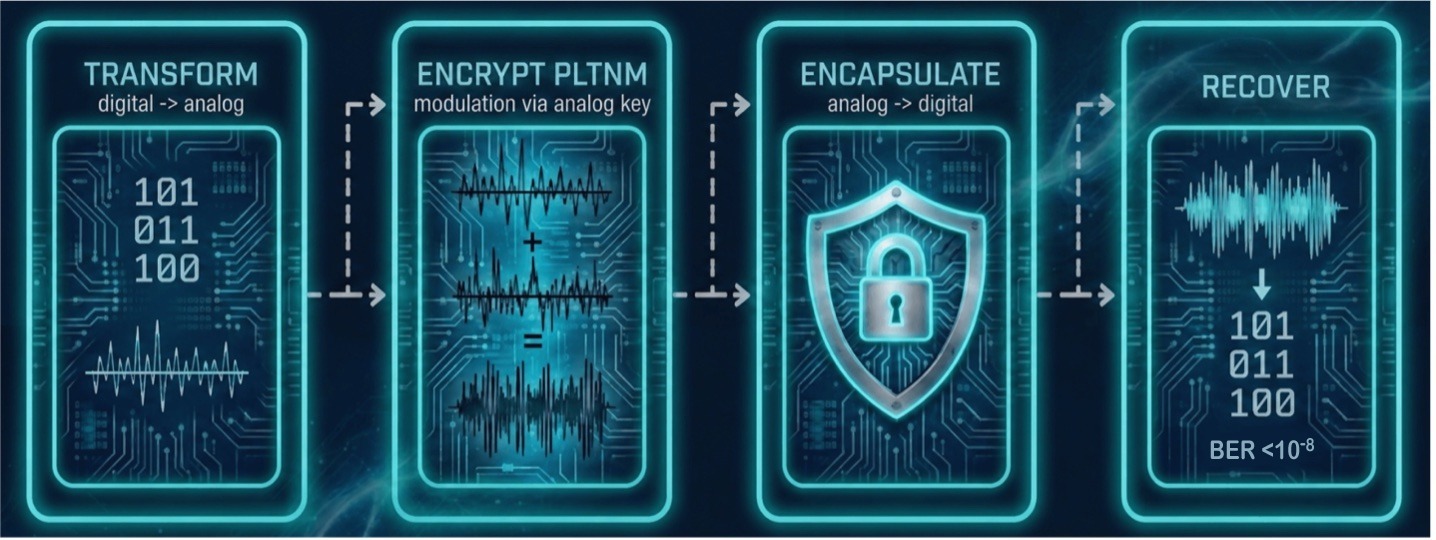
Digital → Analog
Digital files are converted into high-fidelity analog signals, translating discrete binary data into continuous physical waveforms. This alone changes the fundamental nature of what is being protected.
PLTNM Modulation
Phase-Linked Temporal Non-Linear Modulation (PLTNM) is applied via a matched analog security key — producing an output that carries no discrete mathematical fingerprint and no structure an adversary can model or exploit.
Analog → Digital
The protected analog signal is wrapped back into a standard digital file format for conventional transmission or storage. To an observer without the matched hardware, the file carries no exploitable structure.
BER <10-8
Recovery is achieved strictly through the inverse physical-layer process, using the exact matched hardware key — reconstructing the original data with no residual bit errors at the file level. Without the key, there is no process by which the data can be recovered.
Digital in. Digital out. Physics in between.
Compounding Complexity by Design
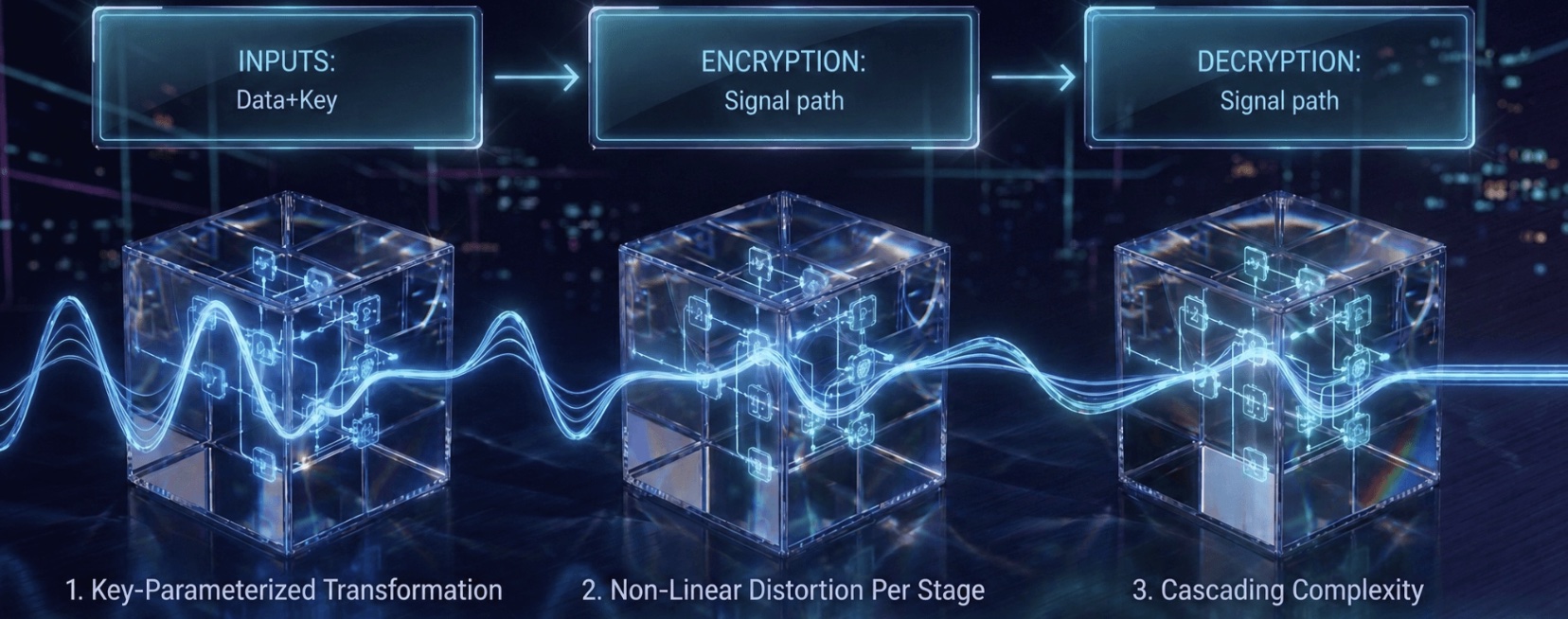
Stacking non-linear stages doesn't make brute-force harder. It leaves brute-force nothing to search.
At the core of Analog Guard is an architecture that changes what decryption requires in the first place. Rather than a single encryption operation, Analog Guard applies a cascaded series of higher-order Phase-Linked Temporal Non-Linear Modulation (PLTNM) stages — each one compounding the complexity introduced by the last.
The transformation is key-parameterized. The data and its analog key enter the signal path together, and the key's continuous physical parameters shape the transformation in ways specific to that hardware instance. No digital representation of the key exists to extract or copy.
Each subsequent stage applies non-linear distortion independently — bending, stretching, and reshaping the signal through physical processes that cannot be practically inverted without the matching key. The effect is multiplicative rather than additive: each stage doesn't add to the difficulty of inversion, it multiplies it, so complexity compounds across the cascade.
What We Will Deploy
Analog Guard® extends security beyond the digital domain by transforming an analog-encoded data signal using one or more synchronized analog security keys. During encryption, the analog signal undergoes a series of proprietary analog-state transformations that produce a protected waveform whose structure is governed by both the information being protected and the analog security key environment. The resulting encrypted signal can be stored, transmitted, or archived while remaining dependent upon the original analog security conditions.
Recovery requires more than possession of the encrypted data. During decryption, the encrypted analog signal must be processed using the exact matching analog security key or key suite that was used during encryption. When the correct analog conditions are present, the inverse transformation reconstructs the original analog waveform, which can then be converted back into digital information. Without the proper analog security key environment, the original information cannot be accurately recovered.
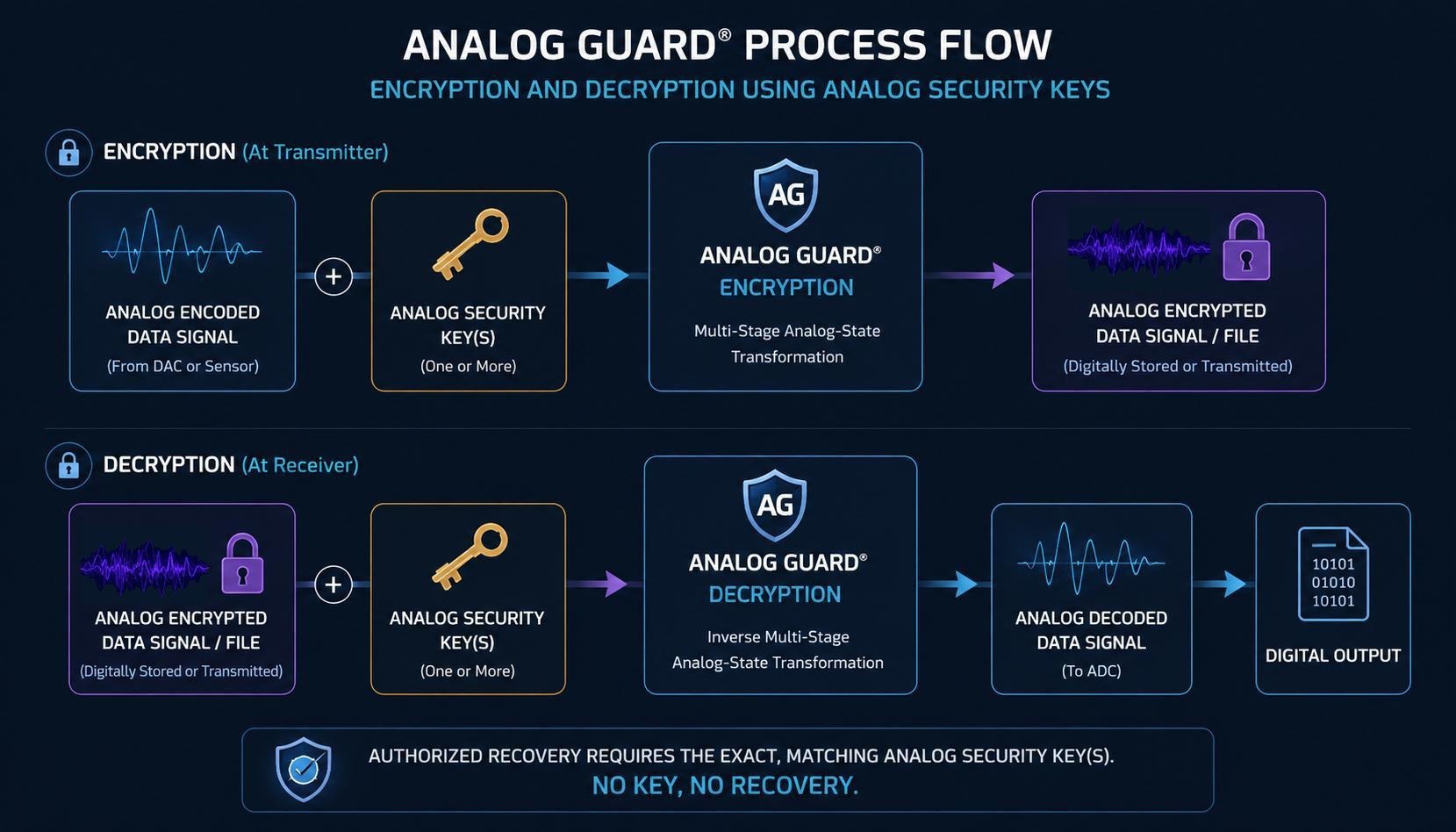
From Analog Protection to Authorized Recovery.
Distributed Analog Reconstruction Key
The Distributed Analog Reconstruction Key (DARK) system (patent pending), establishes a new cybersecurity infrastructure model by distributing reconstruction capability across a coordinated ecosystem of independently governed domains. Rather than concentrating recoverability within a key, credential, device, or central authority, recovery depends upon relationships maintained across synchronization, validation, governance, compatibility, lineage, and analog-state infrastructure.
Authorized reconstruction occurs only when sufficient alignment exists across synchronization, validation, governance, compatibility, lineage, and analog-state domains. When these conditions align, a reconstruction window emerges; as conditions drift, that window closes. Recovery therefore exists not as a stored artifact, but as a temporary capability produced by coordinated conditions across the broader ecosystem.
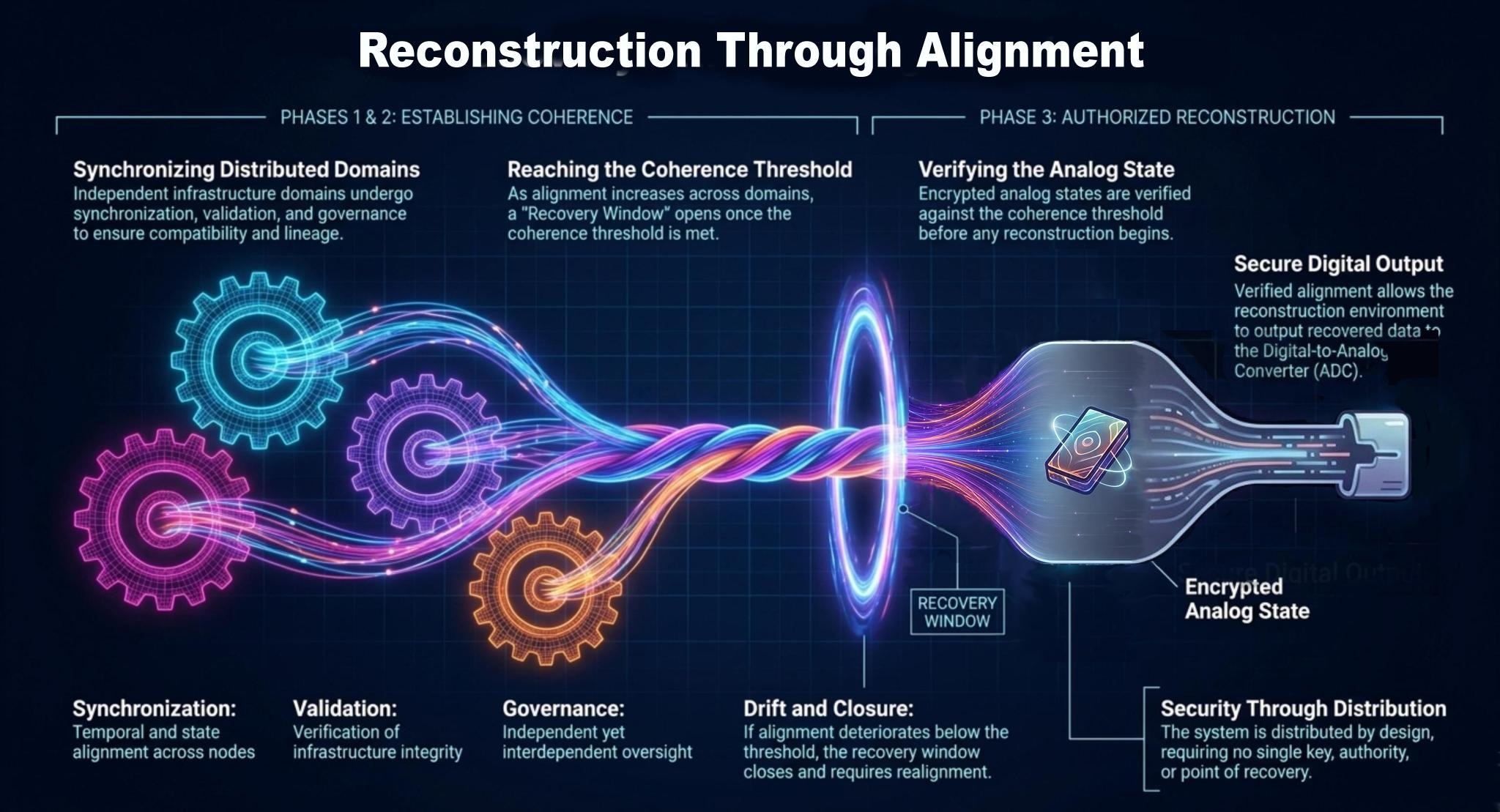
Recovery Emerges ONLY When Conditions Align.