Validation: Time, Frequency & Spectral Analysis
Empirical Validation: Three Domains
Analog Guard’s security claims are not theoretical — they are empirically measured and reproducible. Validation across the time domain, frequency domain, and spectral coherence tells a consistent story: with the matched key, recovery is exact; without it, the output is indistinguishable from noise, with no partial signal an adversary could exploit. The figures below show each stage of that process directly.
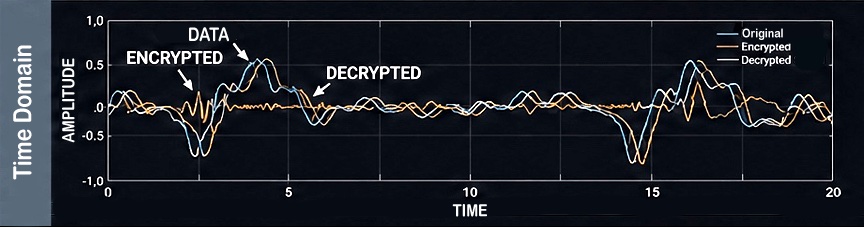
Time domain. The first trace shows the analog-encoded original signal. The second shows the same data after PLTNM encryption — a physically distinct waveform bearing no visible resemblance to the input. The third shows the signal after decryption with the matched key, recovering the original waveform. The encrypted trace shares no structure with the original; the decrypted trace reproduces it.
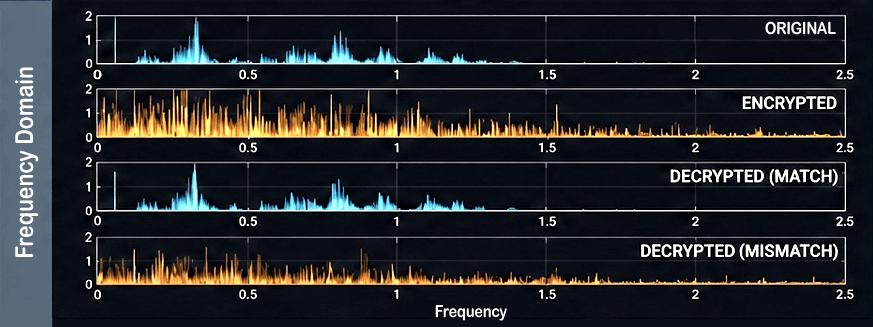
Frequency domain. Comparing spectral distributions makes the transformation measurable rather than visual. The original signal and the matched-key decryption show corresponding spectral content — the recovery is faithful across the spectrum, not just in the time trace. The encrypted signal’s spectrum differs substantially from the original. And critically, the mismatched-key decryption produces a spectral distribution markedly different from the encrypted signal’s — confirming that an incorrect key does not partially reverse the transformation toward the original, but maps to an unrelated output.
Spectral coherence. Coherence measures how related two signals are across frequency, on a scale from 0 (unrelated) to 1 (identical). Three comparisons define the result. Original versus encrypted: coherence varies erratically between 0 and 1, indicating no stable relationship — the encrypted signal carries no consistent trace of the original. Original versus matched-key decryption: coherence holds flat at 1 across all frequencies — complete, faithful recovery. Original versus mismatched-key decryption: coherence again varies erratically between 0 and 1 — a wrong key yields no coherent relationship to the original, no matter how close the key.
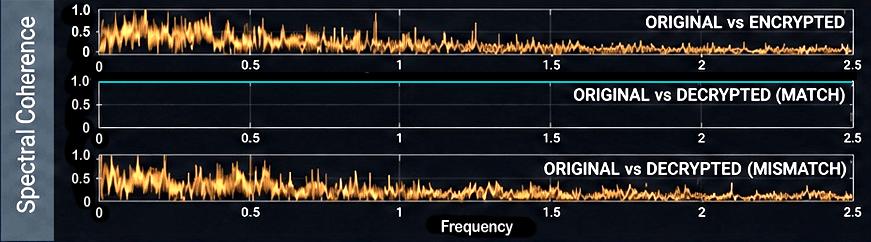
Time and frequency show the transformation. Coherence proves it: a flat line at 1 with the key, no stable relationship without it.
Physical Recovery Metrics
Matched key: exact recovery. Mismatched key: ~50% bit error — statistically random. No value in between for an adversary to climb toward or close in on.
This binary outcome — exact recovery or noise — is not a property of the software layer. It is a property of the physics.
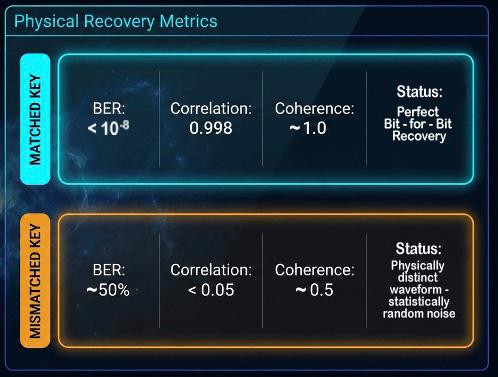
This binary outcome — perfect recovery or pure noise — is not a feature of the software layer. It is a property of the physics.
AI & Machine Learning Resistance
Structural Resistance to Learning-Based Attack
Analog Guard was tested against state-of-the-art convolutional neural networks — GoogleNet and Inception-ResNet-v2 trained on Continuous Wavelet Transform scalograms of encrypted output waveforms.
Training accuracy converged to approximately 100%: the models readily memorized the specific waveform instances they were shown. Validation accuracy, however, never rose above chance — and additional training iterations did not move it. The models learned the examples but learned nothing that generalized to unseen ones.
That divergence is the result. When a model can memorize a training set perfectly yet predicts no better than chance on held-out data, it indicates there is no generalizable structure for it to learn. The limit here is not computational — it does not yield to more data, more parameters, or more training. It is structural, arising from the high-order nonlinearity and continuous parameterization of the analog key space.
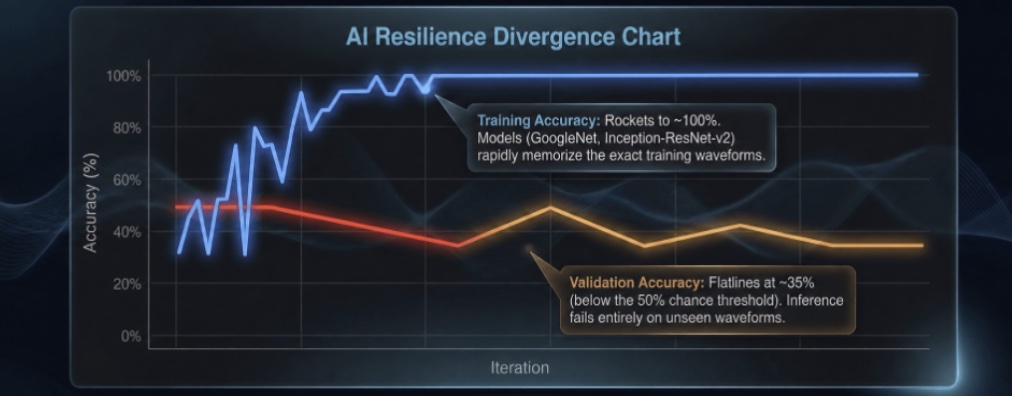
The models memorized every example and generalized none of them. There is no key structure to learn — so there is nothing for more compute to find.